
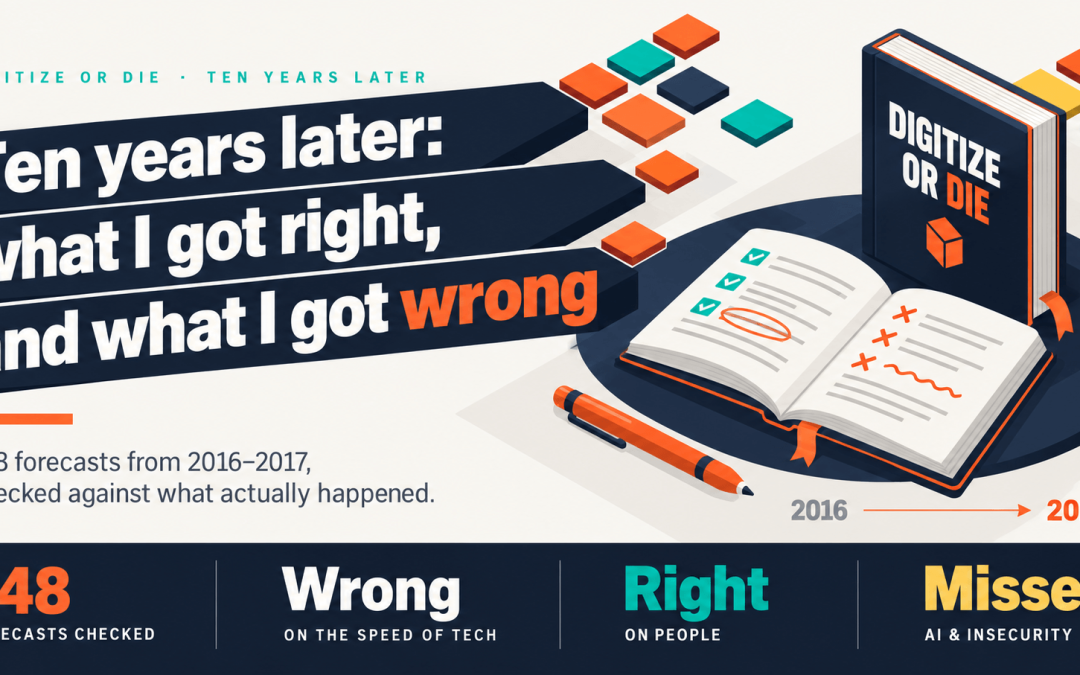
Digitize or Die, ten years later: what I got right, and what I got wrong
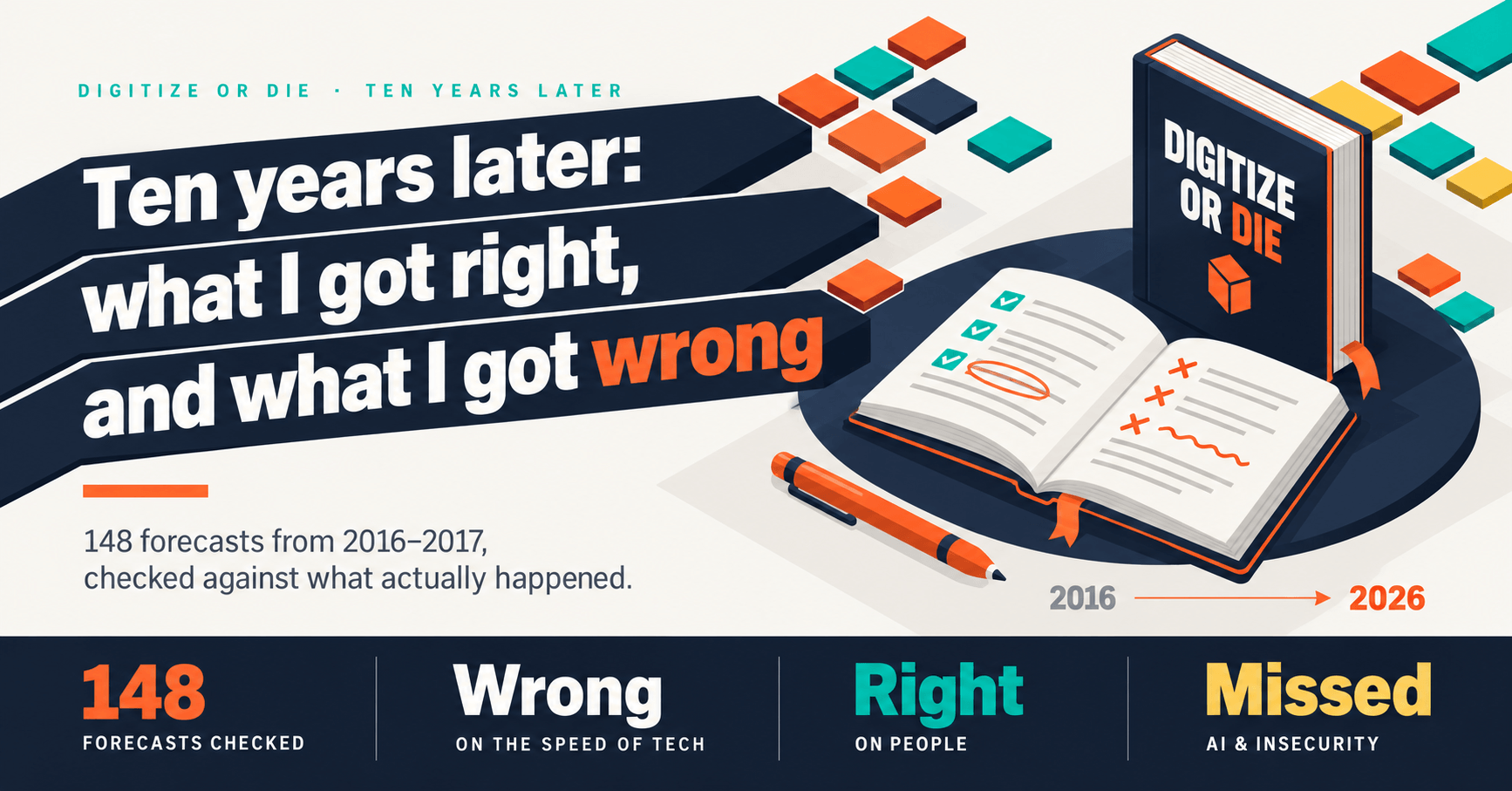
In May 2016 I started writing a book about digital transformation. This summer I reread it with a red pen.
On 5 May 2016 I saved the first draft of what would become The Internet of Things: Digitize or Die. The book came out at the end of 2017, and its premise fit in the title. As I wrote in the introduction: “Digitize or Die: It may sound overly dramatic or cliché, however it is simply the reality.”
Ten years later, I owe my readers a review, and I owe myself one too. I don’t mean a victory lap. I mean a scorecard. I went back to the manuscript and to my 2017–2018 blog posts and listed every forecast, thesis and bold claim I could find. There were 148 of them, so I clearly wasn’t shy. Then I checked each one against what actually happened.
The short version
I was wrong about the speed of technology and right about people. I also underestimated two things: how powerful AI would become, and how high the price of insecurity would be.

Wrong, or early
- ⌛IoT volumesEarly by five years
- ◐Blockchain as “the backbone”Right on use cases only
- ✕Mass unemployment, falling pricesOne out of three
- ◐IoT platformsRight market, wrong winners
Right
- ✓The human factor is the hard part
- ✓Incumbents could still win
- ✓Relationship and data beat the product
- ✓As-a-serviceRight direction, slower pace
- ✓Partners become service companies
Underestimated
- !Digital insecurityRight, but too mild
- !AIRight destination, wrong road
1Where I was wrong, or early
IoT: early by five years, but not wrong Early
The book quoted Gartner: connected things would grow “from 6.4 billion in 2016 to 20.8 billion by 2020.” The companion infographics went further and showed the famous 50 billion.
Reality: 11.7 billion IoT connections in 2020, according to IoT Analytics. The 20 billion mark only arrived at the end of 2025, at around 21.1 billion. And the “trillion devices accessing the Internet” I expected “within a decade”? The current forecast for 2030 is 39 billion.
The technology was ready, but organisations were not. As early as 2017, Cisco found that 60% of IoT initiatives stalled at the proof-of-concept stage. Adoption curves are not set by Moore’s law. They are set by budgets, integration work and organisational patience.
My timing was wrong, but the destination was right. The missing piece, it turned out, was AI. I come back to it below.
Blockchain: right on specific use cases, wrong on “the backbone” Half right
I wrote, in bold: “Blockchain will unlock the IoT promises.” In 2018 I went further: “In a few years, blockchain will be the backbone of digital trust for many large organizations.”
As a universal trust layer for industry, it was not. TradeLens, the flagship supply-chain blockchain built by Maersk and IBM, was shut down in 2022 because it had not reached commercial viability. Enterprise blockchain needed whole industries to agree on shared governance, and that turned out to be the hardest thing of all.
But blockchain did become an accelerator, in specific use cases: smart contracts and digital currency.
≈$300bn
Stablecoin supply
≈$15bn
Tokenised US Treasuries
$1.1bn
Paid by Stripe for a stablecoin infrastructure company
$20bn+
Visa’s annual run rate of stablecoin settlement
The US passed a stablecoin law in July 2025. I had also written that a cryptocurrency “is only worth the trust people put into it.” That part aged well: blockchain took off where regulation created the trust.
I predicted mass unemployment and falling prices One out of three
In February 2018 I wrote that IoT, blockchain, quantum computing and AI would bring “massive unemployment, peak of electricity demand and drop in prices of goods and services.”
I got one out of three. Electricity demand has become one of the defining stories of the AI build-out: the IEA expects data-centre consumption to more than double, from 415 TWh in 2024 to about 945 TWh by 2030. But prices went up, with the 2021–2023 inflation wave, and mass unemployment has not happened. I confused what a technology can do with how fast economies and organisations absorb it.
Platforms: right market, wrong winners Half right
I wrote that “IoT platform in the cloud as a service PaaS will eventually be the chosen path,” and that rebranded legacy platforms “will not last long.” Half right.
The cloud did win. AWS, Microsoft and Google now hold 63% of a cloud infrastructure market worth $143 billion per quarter. But the dedicated IoT platforms I expected to become “the meeting point between all major stakeholders” were scaled back or closed:
The value did not settle in an IoT platform layer. It flowed into the general-purpose cloud, and then into AI.
2Where I was right
The human factor is the hard part Right
This was the thesis I cared about most, and it has aged best. “The biggest challenge of the transition to the IoT lies in the human factor,” I wrote, and more precisely: “The challenge resides in the digital transformation of middle management.” I borrowed a line from a former Nokia CEO:
“Strategy is 5 percent thinking, 95 percent execution.”
Former Nokia CEO, quoted in Digitize or Die (2017)
The data since then is unforgiving:
30%
of digital transformations meet their targets
BCG, 2020
16%
of transformations improved performance and sustained it
McKinsey, 2018
31%
of the expected revenue uplift actually captured
McKinsey, 2022
25%
of the expected cost savings actually captured
McKinsey, 2022
BCG’s most encouraging finding is that companies which get six factors right reach an 80% success rate. Almost all of those factors concern leadership, talent, governance and ways of working, not technology.
My own decade in the field says the same. Since the book, I have led transformation and partner programmes in large, matrixed organisations. The programmes that failed rarely failed on technology. They failed on ownership, on adoption, and on the middle managers who were never brought along.
Incumbents could still win Right
The book attacked two “false beliefs”: that you need to be first, and that you need to be a digital start-up. “It’s not too late for incumbents/analog companies to adapt; they in fact have what is needed to lead and beat competition.”
$311bn → ≈$4tn
Microsoft’s value, from its new CEO’s arrival in 2014 to today
$14bn → $24bn
Caterpillar services revenue, 2016 to 2025
Neither was first. Both used exactly the assets I listed in the book: customers, channels, brands and installed base.
The relationship and the data beat the product Right
“The game will be less about selling products than owning the relationship and the data.”
Digitize or Die (2017)
In 2026, Gartner reports that 67% of B2B buyers prefer a buying experience without a sales rep. When customers can skip you entirely, the relationship and the data are the only moat left.
As-a-service: the right direction, at a slower pace Right, slower
“The move from a product sale to a service sale and from a one-off sale to an as-a-service sale will be the direction most companies will try to move their business.” Gartner forecast SaaS spending of about $300 billion for 2025, so the direction was right. The full outcome-based model is another story: 94% of manufacturers say it affects them, but only 25% have fully implemented it (IFS, 2025). A business-model change is change management with a finance department attached.
Partners would become service companies Right
I wrote that IoT “will very probably force [system integrators] to move from being hardware installers into more software and service driven companies.” Managed services reached about $608 billion in 2025, and cloud marketplaces are expected to sell $85 billion of software by 2028, more than half of it through partners.
3The one I underestimated: digital insecurity
In 2017 I listed “digital in-security” among the defining features of the connected world. I warned that IoT devices “will be ubiquitous all over the planet, controlling more and more things, creating the conditions for major threats to countries, companies and individuals,” and I wrote:
“All networks can be hacked, it’s just a matter of time and means. Will power grids be hacked? Yes.”
Digitize or Die (2017)
I was right. If anything, I was too mild.
A cyberattack had already cut power to 225,000 customers in Ukraine in December 2015, and the attacks have continued since. In 2021, ransomware shut down Colonial Pipeline, the largest fuel pipeline in the US, for about six days.
In 2024, CISA revealed that state actors had been inside US energy, water and transport networks for at least five years, preparing for disruption rather than stealing data.
NotPetya cost Maersk $200–300 million in 2017. In 2025, a cyberattack stopped Jaguar Land Rover’s production for about five weeks. The UK government had to guarantee a £1.5 billion loan, and the Cyber Monitoring Centre estimated the cost to the UK economy at around £1.9 billion, the costliest cyber event in British history.
The average data breach rose from $3.62 million in 2017 to a record $4.99 million in 2026 (IBM). In Europe, 18% of threats now target operational technology (ENISA).
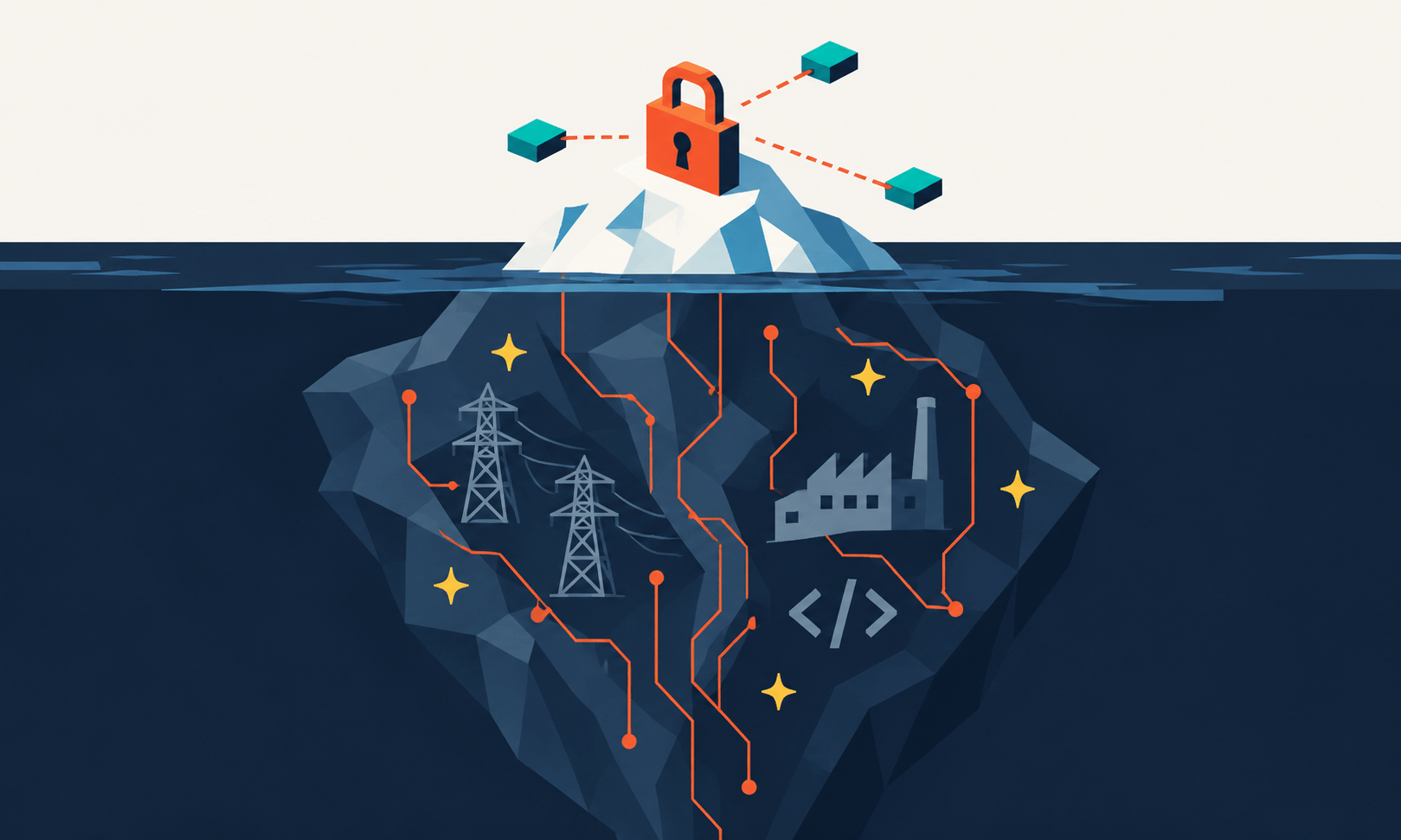
And this is only the tip of the iceberg, because AI is now on both sides of the fight. I come back to this below.
4The missing piece: AI
To be fair to my younger self, I did write that AI would be next: “IoT will create the conditions that will see artificial intelligence relying on big data analytics becoming the next digital transformation.”
I had the right destination and the wrong road. I imagined AI learning from sensors and machines. Instead it learned from language. Now the two roads are meeting.
AI is finally delivering the IoT promise
In 2017 I called the data from connected things “tomorrow’s gold mine.” What the gold mine lacked was a refinery. Three ingredients finally came together:
Structured data
Produced by ten years of connected assets.
Knowledge of use cases
Built up by the people who run those assets.
The power of AI
To turn both into decisions.
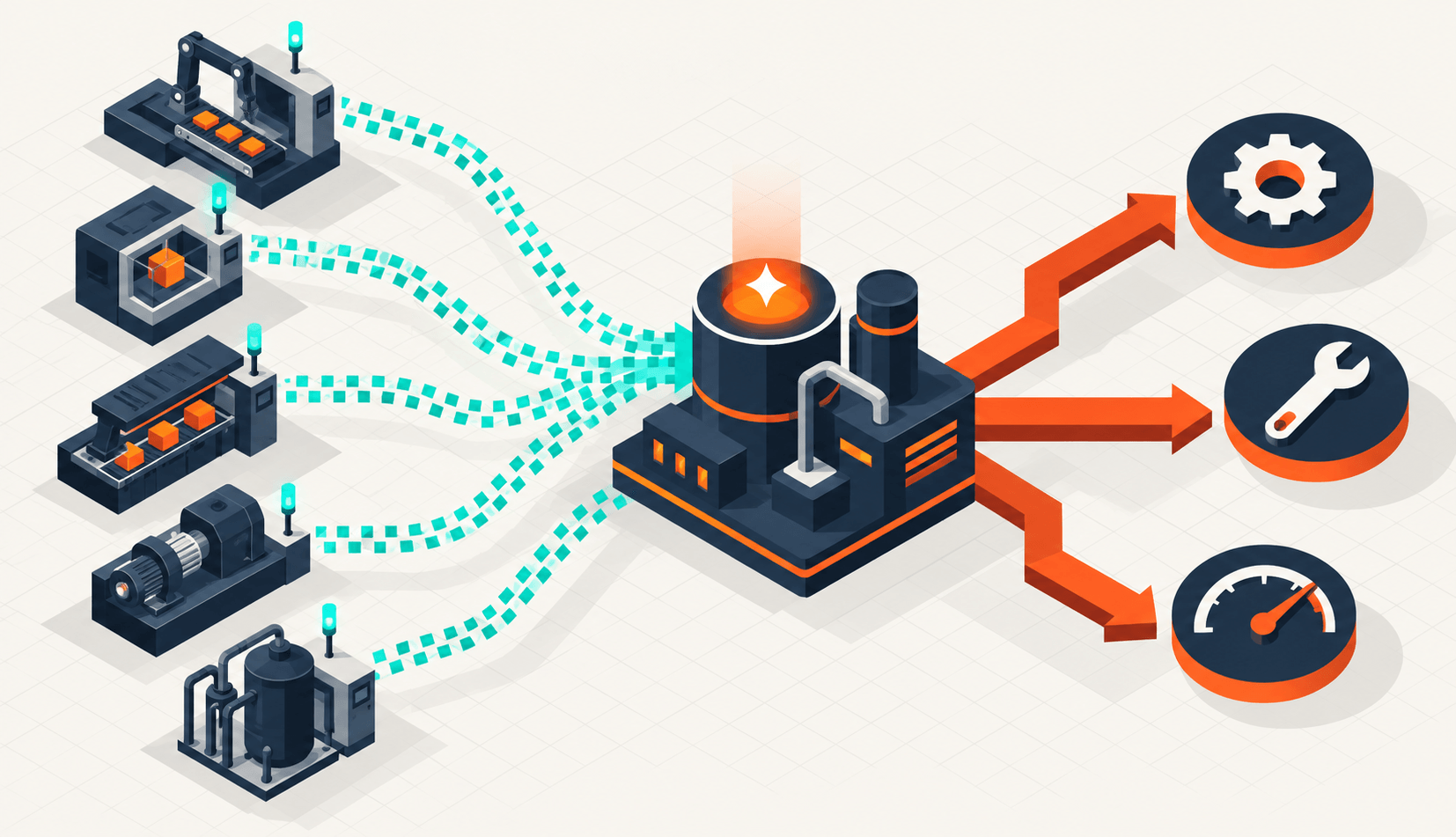
The money follows. IoT Analytics measured $324 billion of enterprise IoT spending in 2025 and expects another 14% growth in 2026, “driven by AI.” It projects the industrial AI market to grow from $44 billion in 2024 to $154 billion by 2030. The factories in the World Economic Forum’s Global Lighthouse Network report productivity gains of over 50%, and most of their top use cases rely on analytical AI.
$324bn
Enterprise IoT spending in 2025, +14% expected in 2026
IoT Analytics
$44bn → $154bn
Industrial AI market, 2024 to 2030
IoT Analytics
29%
of large US manufacturers use AI at scale
Deloitte, 2025
But scale is still the exception: only 29% of large US manufacturers use AI at scale (Deloitte, 2025). This is the same adoption problem as before, with a more powerful technology. IoT was not a failed promise. It was the first half of one.
And it landed on the sales desk
The first function AI reshaped was not the factory floor. It was the sales desk.
In 2017, my book’s only nod to digital selling was a line in the marketing mix, “Price: online quotation,” and one sentence on CRM automation. I did not imagine a seller who walks into a meeting with an account brief built from every past email and call, or who drafts a tailored proposal in an afternoon instead of a week.
What I did have was the method. Step 0 of the book was the customer: “Mapping your customers’ journeys, problems they are trying to solve and hidden needs is your starting point to digitization; not the opposite.” I even gave a template for the value proposition: “Our (products and services) help(s) (customer segment) who want to (jobs to be done)…”
That is exactly what AI now does, at scale:
- Understanding customer needs better. Research and conversation analysis surface the customer’s real problem before the meeting, not after the lost deal.
- Writing sharper, more tailored offers. In 2025, 68% of RFP teams used generative AI, up from 34% a year earlier (Loopio). Salesforce’s 2026 State of Sales finds that 54% of sales teams use AI agents and that creating quotes is one of their top three uses. Time actually spent selling has risen from 28% in 2022 to 40%.
- Personalising marketing and improving products. The same capabilities are personalising marketing at scale and making products more efficient in use.
But the IoT pattern is repeating itself:
−45%
likelihood of hitting quota for sellers overwhelmed by technology
Gartner
3.7×
more likely to hit quota when sellers partner well with AI
Gartner
35%
of sales professionals fully trust their own data
88% / 39%
of companies use AI / see any impact on EBIT
McKinsey
An AI proposal is only as good as the discovery behind it and the CRM data underneath it. Bad data in, eloquent nonsense out.
Without guardrails, AI multiplies insecurity
Here is the part that worries me most. Companies are deploying AI faster than they are securing it, and software development is the clearest example.
- AI-written code. Veracode found in 2025 that AI models chose the insecure option in 45% of coding tasks. Its 2026 report shows no real progress: AI-generated code passes security tests only 56% of the time. When “vibe coding” goes to production without review, the vulnerabilities go with it.
- Shadow AI. IBM found in 2025 that 13% of organisations had suffered a breach involving AI models or applications, and 97% of those had no proper AI access controls. Shadow AI added $670,000 to the average breach.
- Attackers use AI too. In November 2025, Anthropic disclosed a state-sponsored espionage campaign against about 30 organisations in which an AI agent carried out 80–90% of the work. In 2024, Arup lost $25.6 million to a deepfake video call. Microsoft reports that AI-written phishing gets a 54% click rate, against 12% for the classic kind.
AI will keep improving sales, marketing and products. But for organisations that deploy it without guardrails, it will also open the next generation of breaches.
5Six lessons, ten years on
- Technology arrives early, but organisations set the pace.Plan for adoption curves, not technology curves. My IoT timeline was wrong for exactly this reason.
- Govern for value, not activity.A programme dashboard full of green milestones can coexist with zero business value. Define value realisation on day one, and track it to the end.
- Middle management is the transformation.Sponsors announce change, but middle managers decide whether it happens. Bring them in early, give them the story, and make them accountable.
- Start with the customer, every time.Step 0 is still valid. AI makes it faster to skip, which makes it more dangerous to skip.
- Bet on alignment, not on a single technology.Blockchain failed where it needed whole industries to agree, and succeeded where the incentives and the rules were clear. In any matrixed organisation, value is created where divisions and partners agree on priorities.
- Guardrails before scale.Security, data access and human review are not the brakes on an AI programme. They are what lets it go fast without crashing.
6Where this is heading
Rereading the book, one thing strikes me: in 2017 the world I described was opening up, connected and frictionless. The next decade looks different.
Energy and water. Securing electricity and water is becoming strategic, for data centres as much as for factories.
Security, in every sense. Data, data centres, people and transactions all have to be protected.
Turning inward. I expect companies, and countries, to turn inward to protect what matters.
Who captures the value. Value is likely to move towards those who have access to resources (energy, compute, data) and who are able to protect them.
Relocation and vertical autonomy. Reshoring will at least be a strong trend, and companies will seek more vertical autonomy, in medicines, industry, energy, data and AI.
Next post
Five predictions for the next five years
This time I’ll publish the scoring rules at the same time, so that in 2031 you can hold me to them.
“Like every methodology, it will evolve,” I wrote in 2017. The method held up. My timing did not. Let’s see how I do this time.
The Internet of Things: Digitize or Die — the 2017 book this scorecard is built on. All benefits are donated to the Alzheimer’s Association and the Fondation de France.
Get the book About the book
Sources
IoT, platforms, cloud
- Gartner, 7 Feb 2017 — 8.4bn connected things in 2017, 20.4bn by 2020
- IoT Analytics — State of IoT 2020 (11.7bn connections)
- IoT Analytics, Oct 2025 — 21.1bn devices end-2025, 39bn in 2030
- IoT Analytics — State of Enterprise IoT ($324bn spending in 2025)
- IoT Analytics — Industrial AI market
- World Economic Forum — Global Lighthouse Network 2025
- Cisco, 23 May 2017 — IoT projects survey
- Synergy Research Group — Q2 2026 cloud market
- RCR Wireless — Google Cloud IoT Core shutdown
- CIO Dive — GE scales back Predix
- IEA — Energy and AI (2025)
Blockchain and digital currency
- Supply Chain Dive — Maersk and IBM shut down TradeLens
- rwa.xyz — Stablecoins and tokenised Treasuries (Oct 2026)
- White House — GENIUS Act signed (Jul 2025)
Transformation, business models, partners
- BCG — Flipping the Odds of Digital Transformation Success (2020)
- McKinsey — Unlocking success in digital transformations (2018)
- Cloud Wars — Microsoft’s market cap in 2014
- Caterpillar — 2026 proxy statement
- Gartner, 19 Nov 2024 — Public cloud spending forecast for 2025
- IFS — State of Service 2025
- Canalys — Hyperscaler cloud marketplaces
Cybersecurity
- CISA — Ukraine grid attack alert (2016)
- CISA — Volt Typhoon advisory AA24-038A (Feb 2024)
- US Department of Justice — Colonial Pipeline ransom seizure
- TechTarget — NotPetya costs Maersk
- GOV.UK — £1.5bn loan guarantee for Jaguar Land Rover (Sept 2025)
- The Insurer — Cyber Monitoring Centre on the JLR attack (Oct 2025)
- IBM — Cost of a Data Breach 2026
- IBM Newsroom — Cost of a Data Breach 2025 (AI access controls)
- IBM/Ponemon — Cost of a Data Breach 2017
- ENISA — Threat Landscape 2025
- Veracode — 2025 GenAI Code Security Report
- Veracode — 2026 GenAI Code Security Report
- Anthropic — Disrupting the first reported AI-orchestrated cyber espionage campaign (Nov 2025)
- CNN — Arup deepfake fraud (May 2024)